



Essential for some, beneficial for everyone.
Today, the World Health Organization (WHO) estimates that around 17% of the global population lives with a permanent disability. The four most common disabilities are, in order, visual, cognitive, hearing, and motor impairments. But what do these figures actually tell us and, more importantly, what do they leave out?
First, 90% of disabilities are invisible. Second, the 17% figure only accounts for permanent disabilities. Temporary disabilities, such as an ear infection affecting hearing, or situational disabilities, such as being in a noisy environment, are not included. Yet these situations affect all of us at some point. We are all concerned, and we should not forget that age will eventually bring new limitations to everyone.
Television is one of the most universal media platforms. It informs, entertains, brings people together, and accompanies the daily lives of millions. But to remain truly universal, it must also be accessible to everyone.
Digital accessibility means designing services that can be used by as many people as possible, including people with disabilities. Whether internationally through the WCAG (Web Content Accessibility Guidelines) or in France through the RGAA (General Accessibility Improvement Framework), these standards remind us that an accessible digital service must be perceivable, operable, understandable, and robust. In other words, content must be accessible through different ways of seeing, hearing, or understanding it; functionalities must be usable without barriers; user journeys must remain clear; and interfaces must work seamlessly with assistive technologies.
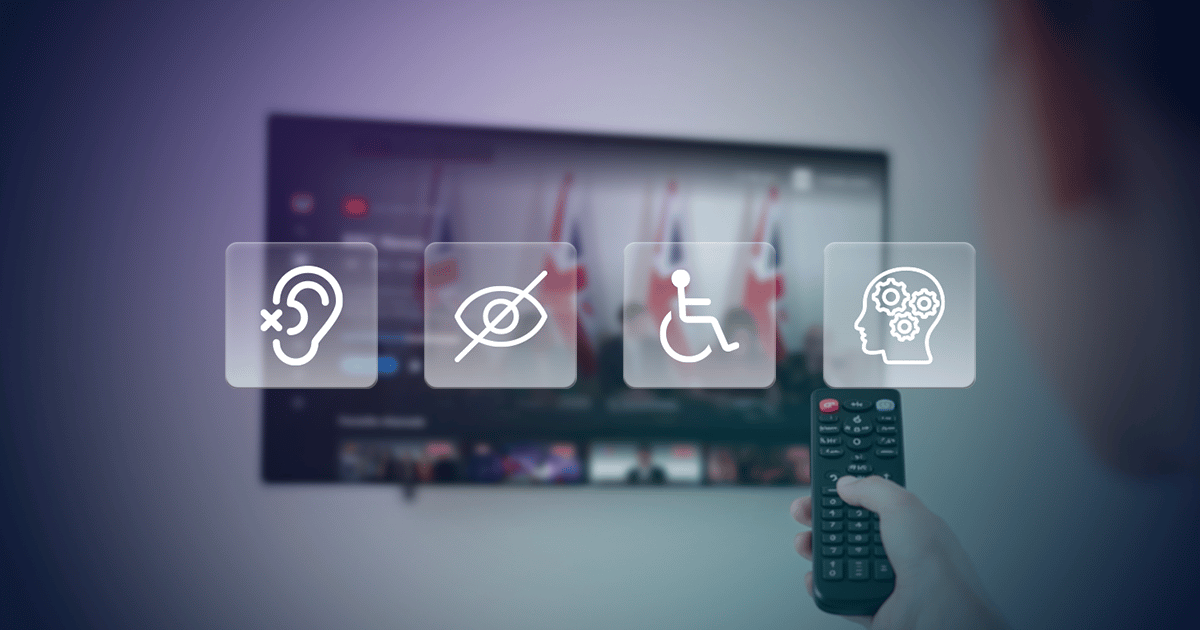
Accessibility in Connected TV
In the ecosystem, these challenges are particularly tangible. Today, users consume content in countless contexts: alone, with family, or in groups; on large or small TV screens, computers, tablets, or smartphones; at home or on the move. Interaction methods also vary widely, from remote controls and touch interfaces to voice commands. Faced with this diversity of contexts, users are not all equal. For some, text readability, visible focus states, keyboard or remote navigation, subtitles, audio descriptions, or compatibility with assistive technologies are not optional features. They are essential conditions for accessing the service.
It is important to remember that accessibility does not only benefit people with disabilities. It improves the experience for everyone. Better contrast, more predictable user journeys, clearer labels, well-integrated subtitles, and simpler navigation all contribute to making interfaces more comfortable, reliable, and intuitive for all users.
Wiztivi’s Commitment
For us, these topics are directly connected to our mission: designing high-performing, useful, and inclusive TV and video experiences. A well-designed solution is not only aesthetic or functional. It must also be understandable, navigable, and usable by as many people as possible, in real-life usage contexts.
On the occasion of the 15th Global Accessibility Awareness Day, Wiztivi reaffirms its commitment.
For several months now, accessibility has become a key pillar of our approach: appointing a dedicated accessibility lead, continuously training our teams, organizing awareness workshops, and progressively integrating digital accessibility challenges into our product roadmap.
This commitment is part of a long-term approach. Accessibility is not limited to a final audit or a checklist of technical fixes. It must be embedded from the very first stages of a project: design choices, navigation architecture, content writing, component development, quality assurance testing, and continuous improvement. It involves product, design, development, QA, project management, and communication teams alike.
To support this ongoing upskilling effort, Wiztivi relies on internally shared reference resources, including RGAA and WCAG standards, training materials, awareness workshops, working groups, and dedicated tools. These resources help spread a common accessibility culture and progressively integrate best practices into our design and production methods.
Our belief is simple: an inclusive solution is a better-designed solution for everyone. By strengthening the accessibility of our products, we improve their quality, robustness, and ability to meet a wide variety of user needs and contexts.
Television is a social medium. Let’s make sure no one is left behind.